
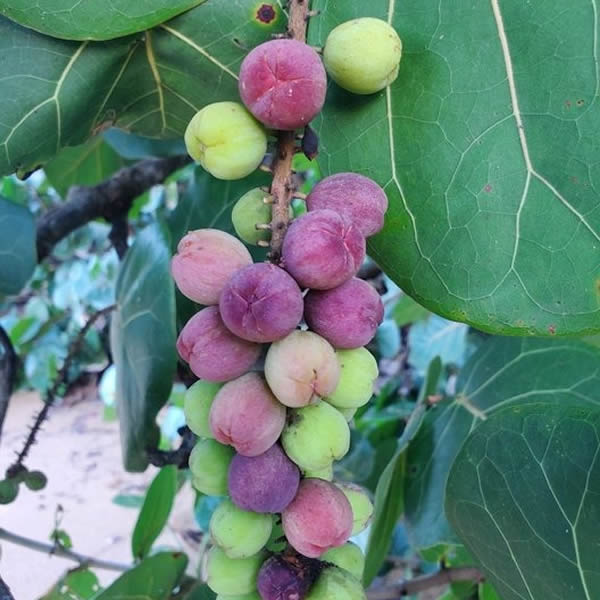
(Coccoloba uvifera)
Sea grape, is a tropical plant belonging to the Polygonaceae family. Its scientific name is Coccoloba uvifera, and it is native to the coasts of the Caribbean, Central America, northern South America, and southern Florida. This species is highly prized for its ornamental value as well as its ecological and nutritional uses.
Botanical Description
Sea grape can grow as a large shrub or a small tree, reaching up to 8 meters in height. It has a twisted trunk and grayish bark, characteristics that allow it to withstand coastal winds. Its leaves are large, rounded, and leathery, bright green with very pronounced reddish veins, making it a very decorative plant.
The flowers are small and greenish-white, arranged in spikes. The fruit is an edible purple berry that grows in clusters and resembles a bunch of grapes, hence its common name. Its flavor is sweet with a hint of acid, and it is consumed by both humans and wildlife.
Habitat and Distribution
The caleta grape thrives in coastal, sandy, and saline areas, where other species struggle to survive. It is widely used in dune reforestation projects, as it helps stabilize the soil and protect against erosion. It is also an excellent choice for windbreaks and tropical landscaping in coastal areas.
Uses
- Food: The fruits can be eaten fresh or used to prepare jellies, jams, wines, and juices.
- Medicinal: In traditional medicine, it is attributed with astringent and anti-inflammatory properties.
- Environmental: It acts as a natural barrier against salinity, wind, and coastal erosion.
- Ornamental: Highly valued in gardening for its hardiness and attractive foliage.
Ecological Importance
In addition to its protective role in coastal ecosystems, the caleta grape provides food and shelter for birds, insects, and other animals, promoting biodiversity in its natural environment.


